


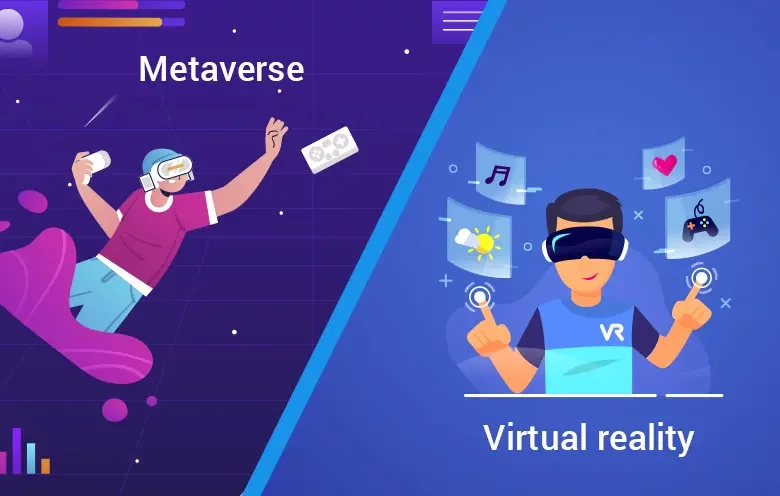

The Metaverse vs. Virtual Reality: 6 Key Differences
- ProductivityTechnology Explained
- August 25, 2023
- No Comment
- 21
The Metaverse vs. Virtual Reality
In a bold move, Mark Zuckerberg’s announcement of Facebook’s name change to Meta in October 2021 brought the term “metaverse” to the forefront. This new buzzword has sparked curiosity, debate, and questions about its relationship to virtual reality. Is the metaverse the same as virtual reality? Or do they intertwine? Here’s a comprehensive breakdown of these concepts and the significant differences that set them apart.
What Is a Metaverse?

The concept of the metaverse isn’t entirely novel; it harks back to Neal Stephenson’s 1992 novel, Snow Crash. In this literary realm, the metaverse blends virtual reality, augmented reality, and the internet, creating a shared virtual space. The contemporary notion of the metaverse aligns with this, offering an evolved internet experience with a focus on immersive virtual worlds.
Key Distinctions: The Metaverse vs. Virtual Reality
If you’re trying to understand the differences between virtual reality and the metaverse, here are six key distinctions.
1. Definition Clarity: Virtual Reality (VR) possesses a well-defined understanding, whereas the metaverse’s definition varies. The metaverse, described by Zuckerberg as an “embodied internet,” remains an evolving concept with different interpretations.
2. Ownership and Players: Unlike VR, which Facebook’s Oculus Rift dominates, the metaverse has multiple players like Microsoft with Microsoft Mesh, expanding its scope beyond a single company’s influence.
3. Shared Virtual Space: While both realms involve virtual spaces, the metaverse emphasizes a shared space, accessed via the internet. VR programs offer confined virtual worlds, whereas the metaverse appears boundless.
4. Accessibility and VR: The metaverse extends accessibility beyond VR to augmented reality and conventional internet devices, bridging the gap between reality and the virtual realm.
5. Blurring Boundaries: As the metaverse encompasses virtual, augmented reality, and conventional internet access, it blurs the distinction between internet browsing and VR usage.
6. Scale and Impact: The metaverse aims to revolutionize work, social media, and internet browsing, transcending VR’s entertainment-focused role.
The Future: Metaverse and the Internet
While the metaverse garners enthusiasm for its potential impact and accessibility, it’s unlikely to replace the internet entirely. While VR offers an alternative to traditional screens, the metaverse offers an alternative to the internet itself, reshaping digital experiences for both VR enthusiasts and non-VR users alike.

Table of Differences: The Metaverse vs. Virtual Reality
| Aspect | The Metaverse | Virtual Reality |
|---|---|---|
| Definition | Evolving concept, embodied internet, shared virtual space | Well-defined, immersive simulation of reality |
| Players | Involves multiple companies, e.g., Microsoft Mesh | Dominated by Oculus Rift, with single company focus |
| Shared Space | Emphasis on shared virtual space accessible via internet | Confined virtual worlds with limited scope |
| Accessibility | Accessible via VR, AR, and internet devices | Primarily accessed via VR headsets |
| Blurring Boundaries | Bridges gap between reality and virtual world | Focuses on providing immersive VR experiences |
| Impact and Scope | Reshapes work, social media, and internet browsing | Mainly known for entertainment and gaming |
This table provides an overview of the key differences between the metaverse and virtual reality, highlighting their distinct features and roles in shaping the digital landscape.





